Executive case study
Decision AI for Manufacturing Excellence
A Fortune 500 pharma manufacturer's self learning causal AI turned early signals into action, catching a 1 Mn$ per batch loss before it happened, one batch at a time.
5 Country GMP Footprint200 Batches / MonthFormulation & API
The Customer
A Fortune 500 Pharma Supply Network
A Fortune 500 global pharmaceutical manufacturer with formulation and API sites across 5 countries, supplying 200+ SKU market variants into regulated markets and institutional tenders.
Supply decisions run across SAP ERP, demand planning, warehouse and transport systems and distributor sell out data, with a vendor base qualified under DMF/CEP. Planning, procurement, manufacturing, QA and logistics each own a slice of the network.
In pharma, a supply failure is not just a cost. An expired batch is a binary write off, a stock out can trigger tender penalties, and a supplier switch is gated by filings and audit history.
The Ground Reality
Why Pharma is Different for the Data Office
Pharma data must carry rules and evidence.
There was no shared ontology between the business and data teams. SKU, batch, site and supplier meant different things across ERP, planning, WMS, TMS and quality systems. Dashboards, spreadsheets and one off studies each held a slice, and none explained why.
Getting data AI ready by hand was estimated at 12 months, based on the annual CDO plan, while ongoing data transformation initiatives still had to be de risked. And AI noise was real. Every business leader brought a new agentic tool that promised to solve one use case at POC, but lacked governance, infrastructure and provenance.
The Decisioning Challenge
An OTIF Failure Never Has One Cause
No single node caused the failure. It was the combination, exactly the pattern a causal chain view is built to catch.
A supplier delay, a batch released late, a forecast error, a customs hold or a sudden demand change can each look manageable on its own. Over a few weeks they compound through material shortages, inventory gaps and allocation constraints into orders not delivered in full and on time to HCPs, distributors and hospitals.
The existing tools could flag an exception, but none could show its cause. Control tower alerts arrived without a why, S&OP models lived in spreadsheets nobody could audit, and every function kept its own version of risk and cost. Trust in AI, skepticism and change management had hit a dead end for internal AI initiatives so far.
The Architecture
Enterprise Brain for your Supply Chain
DecisionX autonomously connects Data, Domain and Process Context into a living Connected Enterprise Brain, continuously learning what changed, why it changed and the Next best action.
On the way in, the brain reads what the network already runs on. Planning and transaction systems: SAP ERP, demand planning, WMS and TMS. Distribution and demand from distributor and CFA sell out. Supplier and compliance records, including vendor CoAs, DMF/CEP and audit. And the tribal knowledge held by planners, procurement, logistics, distribution and CFA teams.
On the way out, decisions arrive in the flow of work: AI reasoning and decisioning, blindspots surfaced 24x7, AI tracking boards and reports to collaborate on. ERP and planning suites stay in place; DecisionX reads from them.
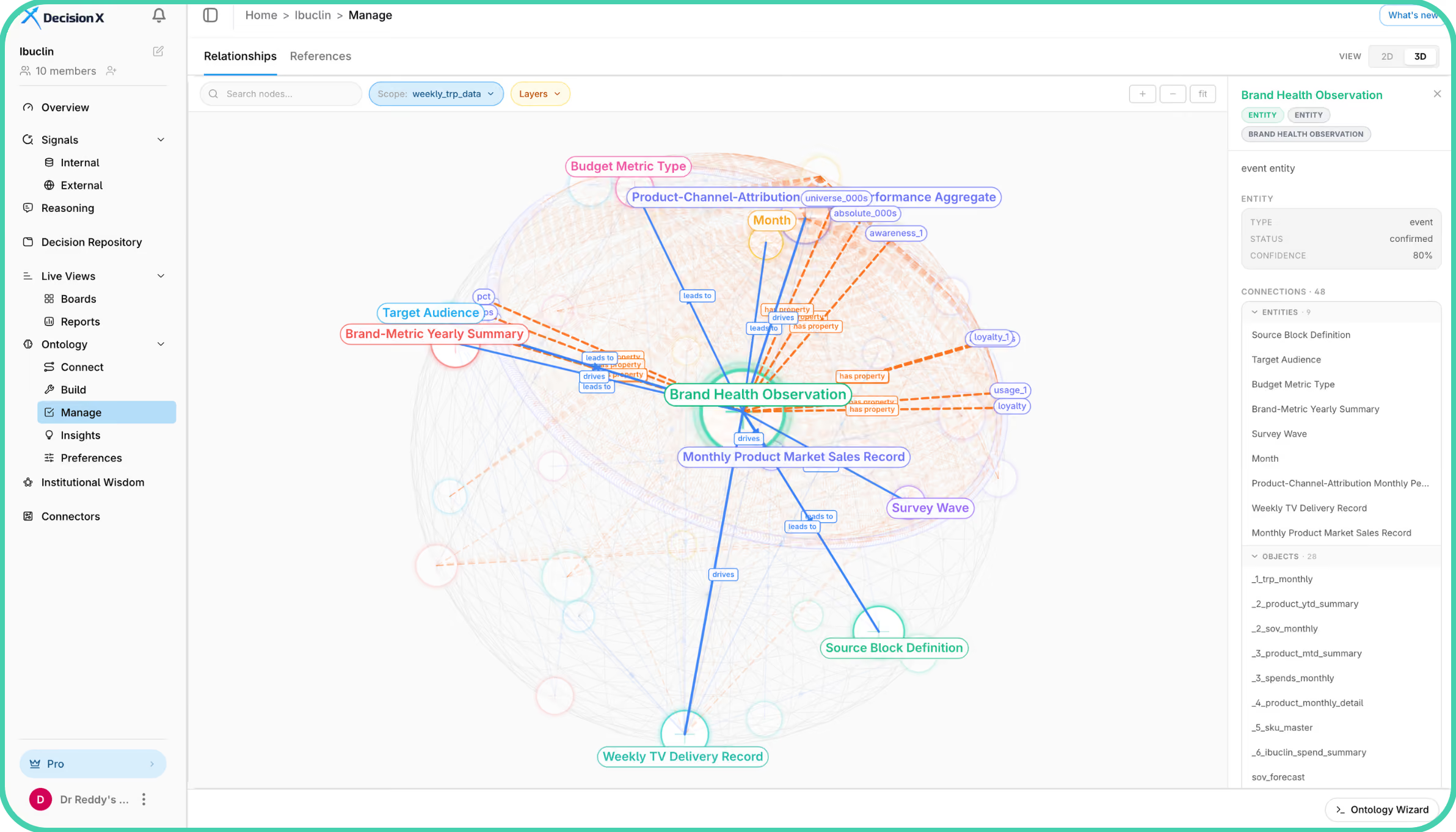
One connected, self learning supply chain brain, governed by the client's own Data and AI team.
The Operating Loop
How the Data & AI Team Uses It
The ontology builds itself. Your Data and AI team governs it.
Ontology agents connect structured data, documents and visuals into one model, and build the data, process, domain and decision layers autonomously. Conflicts surface as they appear, from data gaps to one term meaning different things across systems, such as "available stock" in SAP versus the planning suite, each flagged with a proposed fix the team can accept, edit or reject.
The model stays current as data updates, with every change versioned and traceable. New relationships surface from how business users reason, and are approved with knowledge owners before release, so live answers never shift silently.

The Outcome
Real Impact at Scale
An AI ready foundation in weeks, not a year, and each decision went live faster than the one before.
OTIF root cause went live first, on the new foundation. Cost to serve and supply risk followed on the same ontology, each in about a week. Along the way, 21 tools and reports were replaced, saving around 1.5 Mn $ a year in licences and effort.
Bottom Line Impact
Trusted by